Book

Book

Saturday, 21 April 2018

Wednesday, 24 August 2016

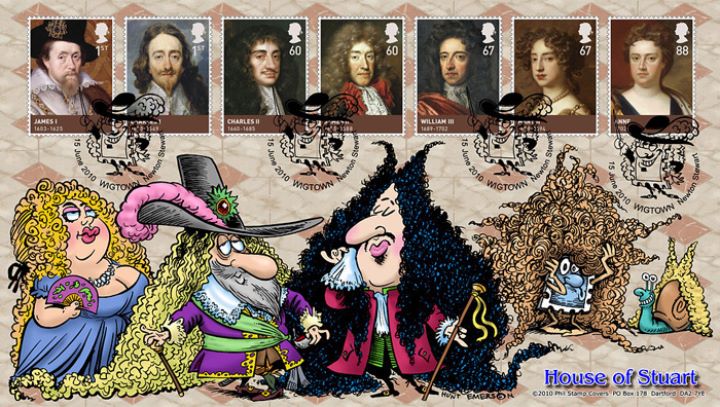
The Stuarts


  • Activities: 
1. Acess the following link for a very nice activity to check your understanding of Charles I, the Civil War and the Restoration: 
  • Summaries: 
Explore the following summaries with necessary information to study the main events in the Stuart Period. You may also consult other sources to go deeper into the topics dealt with in class.  
  • Students' Contributions:
Access the following presentations and summaries in order to study the content presented in class:

- The Glorious Revolution

Wednesday, 29 June 2016

The Tudors

The Tudor Period


1 . Watch the trailers of the movies Elizabeth (1998) and Elizabeth: The Golden Age (2007). What are the movies about? What are the historical events included in them? How is Elizabeth portrayed in the films?
- Elizabeth (1998)
- Elizabeth: The Golden Age (2007) 
·                  Summaries: 
Explore the following summaries with necessary information to study the Tudor Period. You may also consult other sources to go deeper into the topics dealt with in class.  

·                  Students' Contributions:
Access the following presentations and summaries in order to study the content presented in class:

- William Shakespeare: Presentation - Summary


Friday, 27 May 2016

The Middle Ages


·                  Activities: 

1. Watch the video "The Normans in England"
2. Solve the following online activity to learn more about The Norman Conquest: Online Activity
 ·                  Summaries: 
Explore the following summaries with necessary information to study the topics studied in class. You may also consult other sources to go deeper into them.  


·                  Students' Contributions:
Access the following presentations and summaries in order to study the content presented in class:

- The Black Death: Presentation - Summary
- The Hundred Years War: Summary

Wednesday, 13 April 2016

Rounding off Unit 1

On April 12th we worked in groups in order to characterize Wales, Scotland and Ireland. Please post comments on this post so that everybody can read your answers to the questions given: 

- Group 1: "Place the following locations on the map of Wales: Cardiff, Anglesey, Bangor and Newport. What is their significance in the country?" (p. 24)

- Group 2: "Access the Blog and find a link to investigate the responsibilities and powers of the devolved administration in Wales. How is it similar/ different from the English government?" (p. 25)

- Group 3: "Search the web for more information on the main economic activities today in Wales" (p. 35)

- Group 4: "Place the following locations on the map of Scotland: The Highlands, the Lowlands, Edinburgh, Glasgow, Orkney and the Hebrides. What is their significance in the country?" (p. 26)

- Group 5: "Place the following locations on the map of Ireland: Northern Ireland, The Republic of Ireland, Belfast, Dublin and Londonderry. What is their significance in the country?" (p. 29)

- Group 6: "Search the web for information on the period known as "The Troubles". Then look at the following wall paintings found in the city of Belfast. How do they relate to the information you have gathered?" (p. 30)

- Group 7: "St Patrick's Day is a well known celebration that originated in Ireland. What is the relation between St Patrick and the "wearing of green", that is, wearing a shamrock on one's clothing? / Search the net for information about St Patrick's Festival in Dublin. How is it celebrated? Where else in the world is this day commemorated?" (p. 30)

- Group 8: "The following are some of the most salient Welsh symbols. Look at the pictures and find more information about them. What do they tell us about the "Welsh Pride"?" (p. 76)

- Group 9: "Let's work now with the Scottish symbols. Look at the pictures and find more information about them. What's their significance in establishing a distinct Scottish identity?" (p. 80)

- Group 10: "The Irish symbols tell us a lot about the external history and internal history of Irish English. Look at the pictures and find more information about them. Do they relate to the Republic of Ireland, Northern Ireland or both? What do they tell us about the Irish character?" (p. 86)

Thursday, 7 April 2016

Assessment Activity 1: Module 1


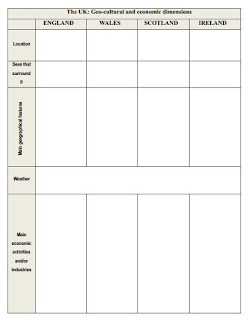
a) Select, summarize and paraphrase the information studied in Module 1 in order to complete the chart on page 37 from your Workbook: 

 AA1

b) Name the document with your last name and a reference for Assessment Activity 1 (example: "García_AA1"). Save the document with a .pdf format and submit it by e-mail to: emilsegf@gmail.com

c) Take into account the deadline: April 17th


Studying Module 1: The United Kigdom


Summaries
Review the contents studied on Module 1 by accessing the following links:

Students' Contributions
Access the following presentations and summaries in order to study the content presented in class:


Tuesday, 15 March 2016

Welcome Class of 2016!

We are going to use this blog to share activities, resources, enquiries, tests and ideas. Feel free to participate as much as you want!


Oral Presentations!

  • An important Assessment Activity for the Course consists in delivering an Oral Presentation on a topic given. 
  • Choose a topic and add your name to the List of Oral Presentations 2016
  • IMPORTANT! Once you have chosen a topic, you are responsible for it. This means that you have to be ready to present the topic on the given date. In case of an unexpected problem, contact the teacher in order to agree on the steps to follow. 


Glossary of Specific Terms

In the link below you'll find the "Glossary of the Subject". We are going to work collaboratively in the construction of this Glossary by including in it specific terms that we need to learn and use in this subject. As you read the material, feel free to contribute with new words for our Glossary. Regards!

GLOSSARY

Thursday, 9 August 2012

Preface


      This book has been designed as a theoretical and practical study guide to be implemented in the seminar course Socio-cultural and Literary Studies of the English-speaking Peoples I in the teaching track at tertiary institutions in Córdoba, Argentina. The wide range of activities included herein will help students in their exploration of the geographical, political, historical and literary dimensions of UK’s culture. It is our hope that in investigating some of the different varieties of English within the British Isles and their main distinctive features, students will become aware of the cultural importance of language and of the respect different nations and their languages deserve.
Through a didactic and reader-friendly approach the three modules present in the book have been designed to be self-contained, and to promote collaborative and autonomous learning. The first module examines the physical, political and economic characteristics of the UK and its most salient literary productions. The second module consists of the varieties of English within the British Isles, its historical phenomena and the subsequent linguistic consequences. The third module analyses diachronically the development of the English language (from Old English to Middle English to Modern English) and the English literature (from the Middle Ages to the 21st century).
Since the use of ICTs has become more and more widespread in the field of education, we have created a free-access BLOG estudiosscyl1.blogspot.com.ar, complementary to this book, with interesting and useful resources and activities. It will help us and our students engage in more innovative and creative work bringing new technologies to the classroom. We believe that by accessing this BLOG we, as teachers, will foster self-learning, self-assessment and the training of research, analytic and writing skills in our learners. 
All in all, the ultimate goal of this handout is not only to contribute to a holistic and interactive education of our students, but also to make them better appreciate and understand the past and present culture of the UK.

Index


Guide on the use of this material

7
Module 1: THE UNITED KINGDOM: Geo-cultural and Economic Dimensions
9
1.1 Geographic characteristics of the British Isles: the land, the weather and the sea
11
1.2 Sub-countries of the United Kingdom and their capital cities
19
1.2.1 The economy and industries
31
1.3 Literary productions
38
1.3.1 England
38
1.3.2 Wales
40
1.3.3 Scotland
43
1.3.4 Ireland
46
Module 2: THE UNITED KINGDOM:  Political and Cultural Dimensions
61
2.1   The spread of English within the British Isles. An Introduction
63
2.2   England, its people and its language
65
2.2.1         Received Pronunciation
66
2.2.2         Cockney
69
2.2.3         Estuary English
72
2.3. Wales, its people and its language
76
2.4   Scotland, its people and its language
80
2.5   Ireland, its people and its language
86
Module 3: THE UNITED KINGDOM: Socio-cultural Dimension
95
3.1 The developments of the English language. An Introduction
97
3.2 Old English (OE)
97
3.3  Middle English (ME)
113
3.4 Modern English (ModE)
125
3.5 Literary history of the English language
      from the Middle Ages to the Twenty First Century
145
  3.5.1 Middle English
146
  3.5.2 16th and 17th Centuries
156
  3.5.3 18th Century
165
  3.5.4 19th Century
170
3.5.5 20th Century
173
3.5.6 21th Century
176
Works Consulted
183

Tuesday, 7 August 2012

Module 1: Geo-cultural and Economic Dimensions


M1 R1: Topographic map of the UK


M1 R2: Climate and Geography in the UK by the British Council.


M1 R3: Link to the Worldatlas web page

M1 R4: Link to the Directgov homepage: Devolved administration in Wales


M1 R5: Britain's Best Breaks: Cardiff


M1 R6: Link to the Directgov homepage: Devolved administration in Scotland


M1 R7: Glasgow, Scotland with Style


M1 R8: Wall paintings in Belfast


M1 R9: Link to a panoramic view of Westminster Bridge

http://www.panoramicearth.com/2787/London/Westminster_Bridge 


M1 R10:  Such a Parcel of Rogues in a Nation, by Robert Burns.


Module 2: Political and Cutural Dimension


M2 R1: Flags of the UK


M2 R2: Text Analysis: RP

Link to "The Story of English", Episode 1, Part 1.


Transcript

08:25 – 09:01

1)      I think, you know, when you does have a particularly foreign accent, whose right in the borders, would firstly be sort of persuaded…gradually sort of conformed with everybody else, and if it didn’t, it’d be ostracized, put out and people go out their way and be unpleasant to make.
2)      When I first came here, I had a working-class accent and thus always sort of …after a while I was ridiculed… When you gradually change your accent so… that dies away.


M2 R3:  Link to an online etymological dictionary


M2 R4: Text Analysis: Cockney


Transcript: 

...
00:06 
I've seen it on the text and in the papers and that, but I didn't really believe it. Then when I got to the game like there was a few rumours flying about. But then like the boss announced the team that I was playing so I was chuffed but nervous at the same time.
...

No, no one knew like, you know, until they obviously would tell in the picture that in, you know, on the channel.
...

Well, I think he just jumps up in it (...) I think.
...

I was waiting for it to go in and as soon as it went in, I couldn't believe it, you know. I just... It was a dream, just a dream. And like I never felt anything like it, I never.
...   

02.30 
I feel me mates in London are answering and saying I'm lucky and that. I know I'm lucky but, you know, you have to give up a lot of things and I was prepared to do that to get what I want, and as for that, I do get what I want. 


M2 R5: Cover of Paul Coggle's book on Estuary English


M2 R6: Text Analysis: Estuary English


Transcript:  


We're gonna do omelets. Omelets are fantastic. They are cheap, they are flexible. You can use all sorts of different things: crispy bacon, mushrooms, tomatoes, cheeses, you name it. 

I think omelets are the kind of thing that don't really get so credit. They do, actually: if they are cooked beautifully, they are incredible.
They are cheap. Eggs are one of the best forms of proteins.
Go free-range kind of eggs, you'll be laughing.

Personally, I use three eggs for a main course omelet. 
Just crak one of these. Get your egg, crak it on the side, open it up. If, for any reason, you get shell in there, use the half of the shell to get the shell out. if you try with your fingers you will be going like these all night and it wont work. 

So, a pinch of salt and pepper, like that. Some people put milk and cream, I don't, at all.

I got a pan. The right size of pan is about sort of 7 inches, I guess.
That's on a medium heat. Whisk up your eggs. Just a little bit of oil, extra virgen overseas is a nice way to go. A knob of butter in there. Then it starts to melt. Give it a chibby amount in the pan. You want to coat the bottom of the pan, like that. 

The great thing about omelets and eggs is that if you get the first one wrong,
then learn from it try again and just get it perfect. If it's too dark, cook it less. If it's too hard, cook it less. If it's too soft, cook it more. 
...


M2 R7:Text Analysis: Welsh English


Transcript:

REV. ELI JENKINS

Dear Gwalia! I know there are
Towns lovelier than ours,
And fairer hills and loftier far,
And groves more full of flowers,

And boskier woods more blithe with spring
And bright with birds' adorning,
And sweeter bards than I to sing
Their praise this beauteous morning.

By Cader Idris, tempest-torn,
Or Moel yr Wyddfa's glory,
Carnedd Llewelyn beauty born,
Plinlimmon old in story,

By mountains where King Arthur dreams,
By Penmaenmawr defiant,
Llaregyb Hill a molehill seems,
A pygmy to a giant.

By Sawdde, Senny, Dovey, Dee,
Edw, Eden, Aled, all,
Taff and Towy broad and free,
Llyfhant with its waterfall,

Claerwen, Cleddau, Dulais, Daw,
Ely, Gwili, Ogwr, Nedd,
Small is our River Dewi, Lord,
A baby on a rushy bed.

By Carreg Cennen, King of time,
Our Heron Head is only
A bit of stone with seaweed spread
Where gulls come to be lonely.

A tiny dingle is Milk Wood
By Golden Grove 'neath Grongar,
But let me choose and oh! I should
Love all my life and longer

To stroll among our trees and stray
In Goosegog Lane, on Donkey Down,
And hear the Dewi sing all day,
And never, never leave the town.


Activity:
Listen to the poem and find examples of the following features:
  • non-rhotic accent
  • thrilled /r/
  • /i/ produced as an /e/
  • -ing as /in/
  • absence of yod /j/
  • Other features

M2 R8: link to a web page with further listening extracts on Welsh English


M2 R9: Text Analysis: Scottish English


Transcript:

-Where's the buttons?
-Oh no, they've installed voice-recognition technology in this lift, they have no buttons.
-Voice-recognition technology? In a lift? In Scotland? You ever tried voice-recognition technology?
-No
-They don't do Scottish accents
-Eleven
-Could you please repeat that?
-Eleven
-Eleven, eleven
-Eleven
-Whose idea was this? You need to try an American accent. ELEVEN, ELEVEN.
-That sounds Irish, not American
-No, it doesn't! ELEVEN
-Where in America is that -Dublin?
-I'm sorry. Could you repeat that?
-Try an English accent. ELEVEN, ELEVEN
-You're from the same part of England as Dick van Dyke
-Let's hear yours then, smartass
-Please, speak slowly and clearly
-SMARTASS
-ELEVEN
-I'm sorry. Could you repeat that?
-ELEVEN. If you don't understand the lingo, away back to your home country!
-Ooh, it's that talk now,is it? "Away back home to your own country?"
-Oh, don't start Mr. Bleeding Heart, how can you be racist to a lift?
-Please, speak slowly and clearly
-ELEVEN, ELEVEN, ELEVEN, ELEVEN!
-You're just saying it the same way!
-I'm going to keep saying it until it understands Scottish, alright?
-ELEVEN, ELEVEN, ELEVEN, ELEVEN!
-Oh just take us anywhere, ya cow! Just open the doors!
-This is a voice-activated elevator. Please state which floor you would like to go to in a clear and calm manner. 
-Calm? Calm? Where's that coming from? Why is it telling people to be calm?
-Because they knew they'd be selling this to Scottish people who'd be going off their nuts at it!
-You have not selected a floor
-Aye, we have! ELEVEN!
-If you would like to get out of the elevator without selecting a floor, simply say "Open the doors, please"
-Please? Please? Suck my w*
-Maybe we should just say "please"
-I'm not begging that for nothing
-OPEN THE DOORS, PLEASE
-"Please" Pathetic!
-Please remain calm
-Oh my God! You wait until I get up there... just wait for it to speak..
-You have not selected a floor
-Up yours, ya cow! If you don't let us through these doors, I'm gonna come to America, I'm gonna find whatever desperate actress gave you a voice, and I'm gonna go the electric chair for ye!
-SCOTLAND, YOU B*!
-SCOTLAND!
-SCOTLAND!
-FREEDOM!
-FREEDOM!
-Going up? 


Activity: 
Listen to the video and find examples of the following features:

  • rhotic accent
  • diphthong alterations
  • -ing as /in/
  • neglect of /t/ 
  • other phonological features
  • Scotticisms


M2 R10: Link to a web page with further listening extracts on Scottish English

http://accent.gmu.edu/searchsaa.php?function=detail&speakerid=82


M2 R11: Text Analysis: Ireland


Transcript:


7:42
I'm an innocent man. 
I spent 15 years in prison for something I didn't do.
I watched my father die in a British prison for something he didn't do.
And this government still says he's guilty.
I want to tell them that until my father is proved innocent, until all the people involved in this case are proved innocent, until the guilty ones are brought to justice, I will fight on. In the name of my father and of the truth!


Activity:
Listen to the extract from the film In the Name of the Father and find examples of the following features:

  •  rhotic accent
  • vowel alterations
  • monothongs
  • other features

M2 R12: Link to a web page with further listening extracts on Irish English